Petunia Whoo lived alone in a small cottage on the edge of the moors. Some time ago, her husband had died suddenly during a winter sickness.
Rising before dawn, the farm lady milks the cows, makes the bread, and splits the firewood for the day. Breakfast is simple—hot porridge with a tab of butter and barely tea with honey.
After clearing up, she goes to the fields to cut, rake, and turn the hay, which she uses to feed the cows, sheep, and goats. Without the hay, the animals would starve, and so would she.
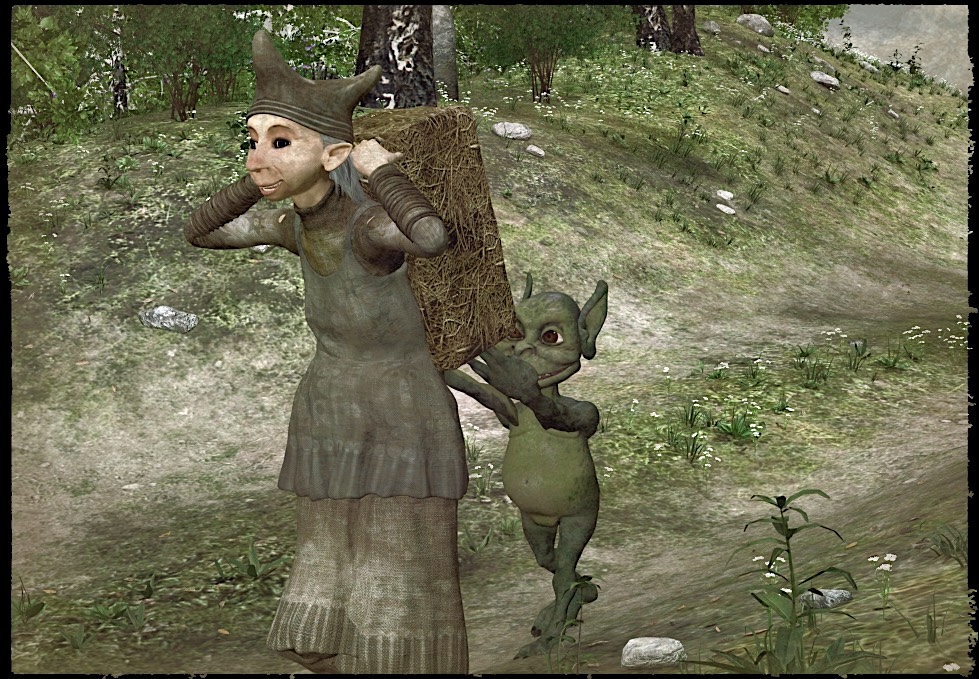
When the hay is dry, the woman makes a bundle and, hoisting it onto her back, returns to the barn to feed her livestock—a back-breaking chore for the old woman.
When her husband died, she worried that having no children to help her would mean she must sell the farm and become a pauper in the city.
One thing she knew for sure was that if one was kind-hearted, good in spirit, and caring of others, the ancestors would send help.
On the night of her husband’s death, she poured a bowl of cream, set it beside the hearth, and prayed to the ancestors to send help with the daily chores.
Nothing happened that winter. No farmhand arrived to carry the heavy loads or mow the hay, and the woman began to think she had been forgotten.
When Spring arrived and the time of haying began, Mrs. Whoo found herself wrapped in worry. “How on earth will I mow the hay, not in the least carry the heavy bails back to the barn? ” she said repeatedly.
One fine May morning, she decided to give it her best try or die trying. After sharpening the scythe, Mrs. Whoo headed for the hay field with great trepidation.
Setting her packed lunch next to the lane, the woman entered the field and went to the furthest corner.
She raised the scythe and swung it across the grass in a wide arc. To her astonishment, the blade moved swiftly, cutting the rough grass like a hot knife through butter.
Within an hour, she had finished half the field and was ready to rest. Setting the food out on clean linen, Mrs. Whoo placed two plates on the cloth, each with an equal amount of bread, butter, and dried dewberries.
She then poured two cups of barley tea and set one off to the side with a plate of food for the ancestors, as was tradition.
After clearing the dishes, the woman wrapped the ancestor’s food in tissue and left it at the side of the lane, saying, “May you take this nourishment as a gift from my home to yours.” Then returned to mowing the field.
To her amazement, the woman had mowed the entire field before the mid-day meal. Placing her pack on one shoulder and the scythe on the other, the farmer’s wife marched triumphantly home.
The following morning, Mrs. Whoo shouldered the rake, walked to the hay field, and effortlessly windrowed the cut grass.
Completing her task, she strolled home, thinking she could make things work out and keep the farm until she passed over to the other side.
After three days of turning the hay, Mrs. Whoo prepared herself to make the hay pails and carry them home to the barn. If she failed, it would all be for naught; she would lose the farm.
Arriving at the hay field, the farmer’s wife made a pile of dried hay and bound it with twine to create a large rectangular bail.
Moment of truth. Bending down, the woman slipped her arm through the twine and lifted. The bail popped off the ground as if it weighed nothing at all.
Down the road, she strolled, reaching home in no time. After several trips, all the hay was safely stored in the barn, and Mrs. Whoo sat enjoying mint tea under a shade tree.
That night, she placed an extra helping of cream in the ancestor’s bowl, bowed deeply, and thanked them for making a miracle happen.
Mrs. Whoo never questioned how it was done. All she knew was that until her dying breath, the old farm woman could do her chores and keep the farm as she had wished.
Who knows what unseen hands help us when we honor our ancestors and thank the ones who came before?


 Folksburywoods
Leave a comment